The epic tale of the worlds and heroes of the LINK
|
June 21, 2010 9:26
Posted By J Serembe
|
Please forgive a brief tally of world events before we submerge deeply into The DOM Royal Contest of DOM Triplo.
It was an age of empire building. Both human and non-human civilizations were in conflict the world over.
In Traisge, Roi Donche I acquired an empire and emulating the Tixtlanis who had done the same, declared himself an Emperor. Consisting of Traisge, Palmaiso, Tamalango, Femer, Meildon and Predische, the Traisgan empire was the world's largest to the date. It would only last for fifty years, but it was a glorious fifty years. Only Palmaiso would remain a permanent part of Traisge.
Tixtlan annexed several kingdoms in it's area of the world, including Tichuan, Celtos and Jingatan.
Moritania united it's kingdom under one flag, the southern Morits defeating the northern Castigs in a particularly bloody year.
Apparently tired of their age-old rivalry Ezmere and Zokesh turned their back on each other and marched in different directions. Ezmere conquering westward adding Zezar and Gish while Zokesh secured the Khaniz Barrens to the northeast under their dominion.
The Jasou renewed their ancient conflict with their cousins the Jousouk to the west. The latter kingdom is where the Porthan mountain Jasou that did not remain as Zenabesh had fled. The Jousouk rededicated themselves to the god Alak and renamed themselves the Jousouk-Alak. They vowed one day to recover the Alak-Ans from the northern barbarians.
Dener underwent a civil war and split into two countries; Dener and Deneron.
The insectoid Cybanis overwhelmed and eradicated the humans living in Cantenka.
The Skaflan had secured the northern portion of their continent and began exporting criminals to the Khaniz barrens.
In Kheldakar the policy of discarding dissidents by casting them into the Obelan to be aspirated to random unknown locations without their memories began.
And Kratox, now free from the cold of the Glacial Epoch attacked and subjugated the lands surrounding their capital.
In DOM, 1,180 was the year that Orsan Fane awarded all 40 families a finely crafted provincial crown, signet ring, and ruling scepter. In doing so, he codified the 40-families as the official provinces of the Kingdom. This replaced the 79 families officially recognized by Keldrun, and replaced the Signet Ring which he had bestowed upon them. This action met with uproar by the families of royal descent that had "temporarily" lost their countries when 79 kingdoms became 40, but they had little say in the matter and had no army to defend their position. To mollify them, Orsan allowed those families to keep the older Signet Rings that Keldrun gave them "as a token of respect."
Next: DOM Triplo
|
|
June 20, 2010 9:02
Posted By J Serembe
|
Years of planning had paid off. Keldrun's Dominion seemed charmed from the beginning. He made good on his promise of Provincial Governments and gave them a level of autonomy. Using their tribute he maintained a standing army that would force any wandering provinces back into line. Trade prospered between provinces with a common currency. He tolerated the non-human races, but fell short of awarding them actual independent dominions. "For their own preservation" he explained. The Esamic Faith became the official religion of DOM. In the south, they remained Paternals, having not had the same exposure to Esam.
Frustrated with the cult of Keldrun Fane, Orsan Fane grew increasingly dissatisfied. By his 50th year (Keldrun was 10 years his senior), Orsan was convinced that he would never be king. Never get a chance to punish those that had slighted him over the years. At first, he sought out Alchemists to help prolong his life. He thought simply to outlive Keldrun. But increasingly, and as he slowly slipped into dementia, Orsan thought of removing his brother from the throne.
Every midwinter since the founding of the Dominion, a celebration is held in Dorcer City - now DOM City and the capital of the Dominion. Keldrun started this festival to discover who among his provinces would owe him enough fealty to make the arduous trek to DOM during the middle of the winter. He would meet with those Governors and give them gifts of title and land. Those that did not show up could count on a difficult year ahead. In the year 1,173, Orsan did not come to DOM. This angered his brother. He sent emissaries the following spring to upbraid him for setting a bad example. The following year, Orsan did come. But with a dark plan. Entering DOM with a large retinue of soldiers, he took up most of the Inns near the small Dorcer Castle. Keldrun had planned to reveal the plans for the brand new and much larger castle on the closing day of the festival. These plans featured the raising of the streets of the central capital to help ward off spring floods. He would never reveal these plans because in the dead of night of Wen 15, 1,174, Orsan entered the King's chamber and strangled the elderly King to death. Esam, who was staying in the castle went missing that night. No one ever saw him after that date. His remains were never discovered. It was later assumed that he was killed by Orsan's entourage and the body removed.
Orsan cried foul and demanded that "the Kings murderers be brought to justice", a demand he repeated throughout the rest of his days, though few believed that anyone else but he did the deed. Keldrun had an heir - an adopted son of cousins both of whom had perished from plague two years earlier. The boy was only ten years old, and Orsan was declared regent. This hapless youth would also disappear a year later never to be found, leaving Orsan as King.
Despite being quite insane, Orsan managed many achievements during his reign. He built the new capital on top of the old, and generally established DOM as the cultural center of the Dominion. He encouraged the arts and loved circuses. But he also had other, much darker sadistic passions. Increasing as he aged, his Kingship became more and more corrupt and chaotic. His alchemists managed to keep him alive until he was 95 years old. In the midwinter of 1,199 in his last year of life - which was mostly spent on his deathbed wracked by dementia, guilt and paranoia, he would set in action a most bizarre method of succession. Despite having a son who would naturally succeed him, he vowed to award the Kingdom to the winner of a contest.
Next: World Empires
|
|
June 19, 2010 1:50
Posted By J Serembe
|
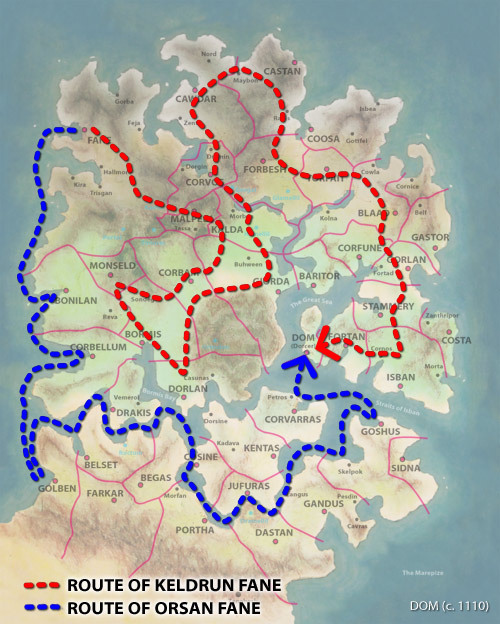
This map depicts the eleven year March for the Dominion Of Man (1,115 - 1,126) that brought Keldrun Fane to the City of Dorcer (subsequently renamed DOM City) to establish a new Dominion cosisting of all of the Kingdoms of DOM (which became provinces). Keldrun became it's first King. He gave Orsan his old job as King of Fane (now Provincial Governor of Fane). Orsan would be next-in-line if Keldrun were to die, or if he did not produce children.
Note: the map title incorrectly reads "1,100". That date marks the beginning of the logistical planning for the march (originating with Keldrun's father Eclan Fane I) and is often used in histories as the beginning date. The actual march began in the spring of 1,115 and ended eleven years later.
|
|
June 19, 2010 1:12
Posted By J Serembe
|
Five years had passed since the first meeting between Keldrun Fane and Esam. During that time both had been busy. Esam was fairly well known throughout the land, but it did very little for his original intent to restore the dignity and respect of non-human classes. Keldrun had met many times with Esam and had assured him that he agreed that justice should be brought to the maligned classes, and that the "Esamic Faith" should be brought to all men.
Keldrun and his brother Orsan finished preparations for their historic march of conquest. As their Fuegonite ancestors had done before them, they brought Orog into their army. Keldrun marched his armies overland and Orsan's fleet of oarships by sea. They travelled with banners declaring themselves the army of the Esamic Faith. Keldrun would meet with kingdoms that had been previously been conquered and assure them rulership of a province if they would join him. And if they would march on their opressors, he would award them their land as well. Esam himself joined the march and the Esamic Faith washed across the land as well.
The bloodiest of the conflicts were felt in Castan, Forbesh, Corbam and Blaad. In Corbam, Keldrun received a measure of aid from the Grimdon and the Trocs and so won the day. In Forbesh, the ancient home of the Temple of Fuegon, the leaders there saw themselves as the inheritors of the Fire of that God and were unwilling to bestow that mantle back upon Fane. Keldrun feigned respect for that request and the Forbesh agreed to help defeat Castan in exchange for the that countries land. "After all we were all of Fuegon when he walked." Remoteness of that country and the hardiness and size of the average Castan infantryman relegated three-to-one odds to nearly being even with Fane, but with Forbesh's help Castan was defeated. In the end, however, Fane turned on Forbesh and eradicated any claim to the Fuegonite lineage that they shared by murdering the entire royal family and decrying it as unknown treachery. In Blaad, Fane fought against superior weaponry, although they certainly took advantage of those arms after they finslly won out due to their superior numbers and superior tactical acumen.
At sea, Orsan had been equally successful. What he lacked in force of Esamic faith he made up for in sheer brutality and intimidation. Orsan had even less interest in the non-human populations than Keldrun pretended to have.
In the year 1,126 the forces of Keldrun and Orsan Fane met at the Kingdom of Dorcer. Keldrun armed with war-hardened men of Fane and countless other Kingdoms, Orog, Grimdon and Red-bearded Castan renegades. Orsan with a fleet of ships packed with hardened marines. The poor Dorcers realized that this avalanche had unstoppable momentum. They handed over their Kingdom without a fight.
On the turret of Dorcer castle Keldrun Fane addressed the armies gathered below. "We have written the new history of our land. None before us could stretch their arms from east to west and call all their own - but we can and do. This Dominion Of Men shall outshine all of the civilizations of old. And we shall pass the memory of this day down through the generations of men." It was a rousing speech to many. Noticeably absent from record is mention of non-human classes. And Orsan would later complain that he was not given a chance to speak. Esam was brought in to say the final words and mend Kenldrun's omissions. From that day on, the new new kingdom was officially "The Dominion Of Men" - shortened to the acronym "DOM" which was later described by everyone simply as an abbreviation of "Dominion."
Next: Death and Murder
|
|
June 18, 2010 7:18
Posted By J Serembe
|
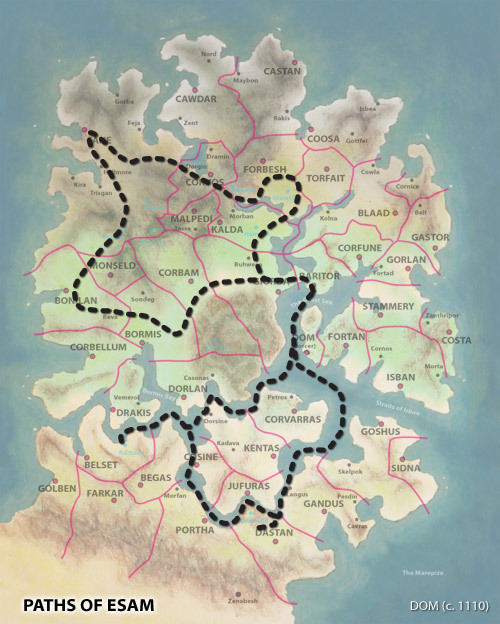
In the year 1,090 in the Kingdom of Baritor, Esam was born to a peasant family that had moved to City of Baritor from the west seeking an education for their son unheard of anywhere but in Baritor. Esam was a bright child, and his father petitioned to have the child raised and taught by the Shamanic "water people" of Baritor. Ultimately he was chosen not for any special gifts that he possessed, but because as a toddler he had met and played with raylan children from Glamellil when he lived in the west. Exposure to the Air element was just enough to place him over other lilkely candidates. And he could speak very, very well. He proved to have a natural aptitude for Shamanics and progressed quickly. He grew curious about the other Elemental Magics and determined that one day he would seek out more knowledge about them.
This was a time in history when non-human races were looked on suspiciously and fearfully by men. By the year 1,000 provinces began annexing the lands of non-humans and started a slow march toward genocide of those classes. Esam could not tolerate this and as a young man became an outspoken critic of the persecution. This did not earn him any friends. But being a clever sort, he realized that if the people could appreciate the Elements once more - in addition to their Paternal faith, then they might learn to tolerate the other classes so intrinsically linked to those elements.
"The Fiery sun is our protector. The mother moon moves the waters of our shores and in our souls. The air bathes us with cooling kindness, or like the baking heat of the sun punishes us for our misdeeds. And the great earth that houses and nourishes us makes up the whole. For without all of these four, we are nothing."
Esam was a particularly charismatic and talented orator. Even at the tender age of 18 people would come to hear him speak and few were not moved by him. He undertook a journey across what would become DOM, making a point to stop at all the non-human dominions. Being a human, all but the Rayla mistrusted him. Eventually the Grimdon gave him proud but cordial recognition. He nevertheless spoke up for them in his indirect fashion.
Byt the time he had reached the Kingdom of Fane, he had amassed a following of over a hundred, including two Rayla and one Grimdun.
It had been a long day. Everything was falling into place. He had finally gotten Orsan to agree to travel by sea and he land. He hated the sea. He wanted to feel the miles beneath his feet. Cawdar had agreed to join him. A long day, but a good day. Now this. A cleric stirring things up. Could be dangerous. As he sat there, King Keldrun of Fane casually greeted the young man walking up to stand before him. "Your eminence…" he began. The king had meant to stop him at one point, but forty-five minutes later the young orator stopped on his own. He had made his point. To say that the King was impressed would be putting it mildly. Days later, Keldrun asked him back. This man could be very, very useful.
Next: When Kingdoms Became One
|
|
June 18, 2010 7:18
Posted By J Serembe
|
Illustrates the route that Esam took on his pilgrimage throughout DOM starting and ending in Baritor. It can also be noted that DOM consisted of only 40 Kingdoms at this point. Cawdar was an "ally" of Fane (actually more of a puppet government of Fane than an idependent entity).
|
|
June 16, 2010 9:51
Posted By J Serembe
|
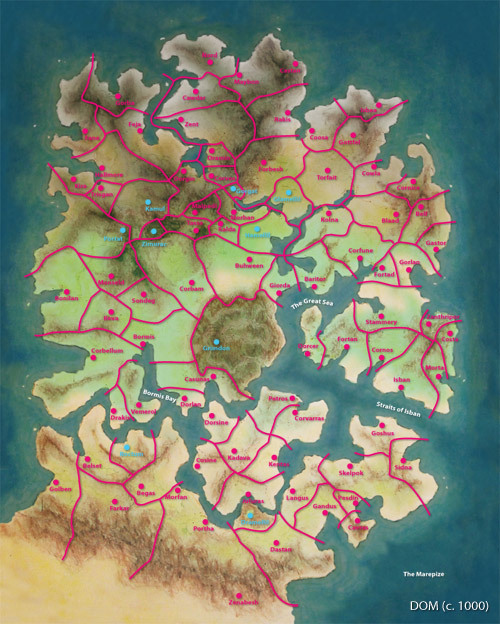
The Domish Kingdoms c. 1000. Each Kingdom named after the family in control, the city-state bearing the same name. Borders stabilized for the most part at this time. The regions marked by a blue city-state were non-human dominions. By 1100, even these regions would be claimed (though not entirely subjugated) by humans.
Click for larger map
|
|
June 16, 2010 9:51
Posted By J Serembe
|
By the year 800, a common language had developed and trade between tribes had become commonplace. As populations grew, land and land ownership became more of a subject of contest and conflict. There had always been fighting between tribes over access to water and other issues and these dispute would often turn violent. The fact that they generally shared the same religious faith did not matter much, the vast majority were not very religious.
Sometime around 900 things started turning more violent with larger tribes attacking and swallowing smaller tribes. The leaders of the victorious tribes took to calling themselves Kings, emulating the Grimdon Kings of old. They started to amass small paid armies and demanding tribute from the rest of the conquered tribes. They marked their lands with flags or other markers and named their small Kingdoms after their own family names. The use of iron and bronze was common by this time. In year 800 there were 316 known human tribes in DOM. By yr. 850 there were approximately 237. By yr. 900 there were 158. This pattern of conquest and expansion would continue for remainder of the millennia. In the year 1000 there were only 79 human Kingdoms left and only nine areas under the dominion of non-humans.
Heilus Blaad was all alone. He already knew that this time it would turn out differently. Just the look of it. They way it had cooled. Last time there was just too much charred coal. Too much wrought metal. But it had been promising nonetheless. He turned out his new issue and grabbed a hammer. He loved the heat. Like the warmest summers day in the middle of winter. He felt whole in the glow of metal. He figured that there was some Grimdun in him. As his hammer came down on the glowing mass, he knew he had gotten it right. And in the presence of his glowing furnace, like a avatar of old at his gem of Power, he let out a gasp of joy and awe. He knew that he was standing before the finest metal that anyone had ever seen.
Next: Esam
|
|
June 14, 2010 9:42
Posted By J Serembe
|
The Age of Magic was long forgotten. Civilization was reduced to small tribes banding together or going it alone. By the year 100 the Glacial Epoch was seriously on the run. Summers lasted longer, and long frozen lands had begun producing flowers in the spring. Men began farming small patches of land and trading their produce within their tribe. That they had achieved the production of bronze tools a millennia earlier had been lost to all but a few, and those that practiced the art did not manufacture more than they needed. In warmer Traisge half a word away, organized armies marched on their enemies and La Dame appeared to the faithful, but in DOM warfare consisted of small tribes clashing with each other over hunting and land rights.
In Domish Isban the tribes there had long ago abandoned Necromancy and the worship of spirits or deities. Their ancestors had seen these come and go. The only thing that remained constant was the sun and the moon. A group of the Isbani who called themselves Paternals believed that all things were shown to them by the life-giving father sun and the soothing mother moon. The Paternals held ritual holidays and celebrations dedicated to their faith. "Efrem" was a third-generation Paternal, but supposedly one of the greatest orators of his time. He led many to the faith. A cult mostly of personality, he assembled a tribe only of the faithful and moved them to modern day Dorcer province.
"My friends and brothers, my sisters and children" began the great man. He was perched upon the roof so all could see and hear him. "Behold the glorious Sun shining down upon us today. He is glad that we give him thanks and praise. Feel the warmth of his golden light. Each day we praise him we are more blessed…"
You get the picture. The fact that each summer got warmer certainly did not hurt his message. Even after the death of Efrem the faith spread a little farther each year. By the year 300, most of the tribes of the area formerly known as Isban believed in it. It helped homogenize the various languages spoken into a common tongue that was a forerunner to modern Domish.
In the north, the Castans (as they were now called) had held a faith that harkened back to their Moritanian origin. Called Matmus-Necmus it was based on the concept that there was a constant struggle maintaining balance between good (light, order, Matmus) and evil (darkness, chaos, Necmus). But there were few fervent believers among these hardy immigrants. And so, when they were exposed to the Paternal faith, added it to their own. With a few alterations. Matmus became the sun and moon, and Necmus the darkness. Thus, to maintain balance, you were to hold the line when the sun or moon was out. But on those occasions when it was not, you partied like there was no tomorrow. This ritual eventually spread south (would you have stopped it?) and so by the year 600, pretty much most of the continent was of the Paternal faith, and a new moon was a lot of fun.
Magic was still practiced by a very few, and not in the public eye. Spell-casters would take an acolyte or two and the knowledge was passed down. But most people feared Magic and banished the practitioners if they discovered them nearby. One exception to this could be found in the area of modern day Baritor province, where men had associated with Sahag in earlier millennia and the rudimentary Shamanism that they practiced had become part of their culture. They incorporated it locally into the Paternal faith. These were known as the "Water People" and would much later produce a man that would make a great deal of history.
Next: Early Domish Feudalism
|
|
June 13, 2010 3:10
Posted By J Serembe
|
In the deepest heart of a verdant place far from DOM there lie a forest that was home to a single Raylan tree. This was long ago. In a land that was to produce the greatest army and the largest empire that the world would know for a millennia, such a delicate thing would not survive. No one knows exactly when it died. But Legend says that before it did, it emitted a single tear. That tear took the form of a beautiful, ethereal woman. This was no vengeful goddess. She would become the patron saint of the Traisgan people and be so revered that their calendar would mark the year of her first known appearance as the beginning of a new age of man.
For three days the Femite army had been on the run. They had burned houses and eaten livestock along the way. Jaques could not blame them. It had been their land less than a generation ago. "Did we burn them out as well?" he thought. He really did not want to know. He knew they had to be tired and he pitied them. This did not mean that he would avoid their swords. It made no difference to carrying out his orders. He had always carried out his orders.
They broke camp in the early morning. By noon, they had overtaken the Femites. They drew their bows and let fly. Scrambling for position the Femites returned little. Jacques and the Traisgan army pressed forward. Soon they met arm to arm. The angry clash of metal rent the air. The cries of pain were heard by peasants covering in burned out hovels a mile away. Jacques jumped across a small ravine skirted by trees. He saw movement. Suddenly he found himself squaring off with a sharp-eyed opponent. He fought off the sudden feeling that he had met his death. Bringing up his short sword his opponent met him with his. An able opponent thought Jacques. This would be a battle of wills. Then there was no time for thought. The two men met blow after blow, dodging trees, jumping rocks. The world passed by in slow motion. Their blades locked. Both men using the second of opportunity to breathe. But Jacques lingered a split second too long. Suddenly he was in his favorite place. He was inside the hollow tree on his grandfathers farm. It was raining. He was 10 years old. He clung to the moment as the world grew dark. Suddenly there appeared a face in the tree opening. A radiant face smiling at him. A hand was offered. He took it and left his refuge. They did not speak. She caressed his forehead. Jacques never had known his mother- she had died during his birth, but he imagined that she could be no greater than this. He placed himself in her hands and closed his eyes. Three days later he heard a voice. "You're going to make it" he heard. He opened his eyes. The smell of death surrounded him. He could feel nothing. He could not move. She stood in the doorway. But it was the healer that was speaking. Jacque attempted to speak. "I see her" he wheezed. "She came to me." He looked toward the doorway. And with a smile, she was gone.
Next: The DOM Paternals
|
|
|
|

