Archives
You are currently viewing archive for June 2010
|
June 9, 2010 10:19
Posted By J Serembe
|
Atarus realized that altering the reality of hundreds of people was an achievable feat. He had, in effect, made himself a deity to the people of Kor. He had inherited a factious prison island with prisoners that hated each other, but loved him. He organized the peoples into four groups and eventually separated them onto four islands surrounding the main land mass.
The islands proved to be rich in magma-crytallized gems, some capable of holding Power. He erected an Obelan on each island. Dedicating each to a specific element. He taught the population different schools of Magic corresponding to each element. He had designed a microcosm of the world at large. Only Earth (Kor) was lacking as he had no knowledge of Kinesis. Almost on cue, at around -1,555 a ship of Jasou explorers landed on the main island. Among them was a Kineticist. They fell under the spell of Atarus' vision of a utopian society.
By -1,550 Atarus' Obelan were soaking up Power and doling it out to the population of the island. His plan was a success. But not yet complete. He had begun to believe that we was indeed a form of God. He wanted to test his grand plan on a global scale. He took epic shamanic journeys to help determine locations, and he took telekinetic expeditions to the far corners of the earth. He became his own age of magic in a world now nearly devoid of it. He gathered creatures from his visits, creating new life forms through Transmutation and Necromancy. And his penultimate achievement was the production of a "perfect" sentient species, the Kheld. Men borne of Transmutational Fire (Khelna). He utilized the primitive tribal human inhabitants of Brechbada so as not to alarm his own population with the threat of being experimented upon. He combined these humans with the powerful Halic beast of mountainous Halian, and the strong but primitive Cyban Betlen - a sentient insectoid being to the north of Brechbada. For advanced perception he sought out the fabled Rayla of the northern Brechban forests. The only other groves of Rayla outside of DOM. From them he learned of the existence of the other groves. He named his entire collection of islands "Kheldakar" (watery home of the Kheld) in honor of his creation.
Next: Atarus Returns Home
|
|
June 8, 2010 6:29
Posted By J Serembe
|
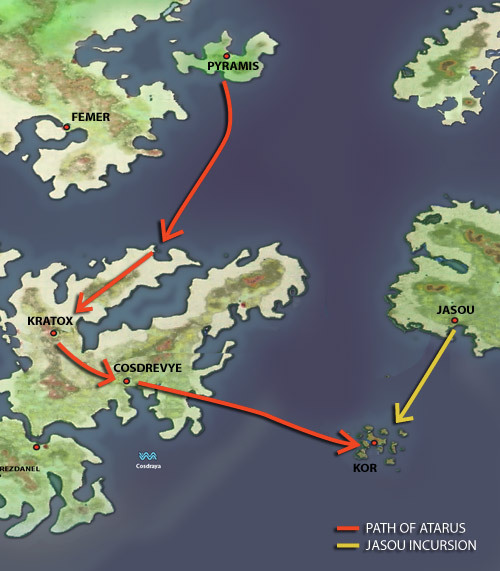
Landing on the shores of Kratox was tantamount to a death sentence. Humans generally were not welcome there. But the Glacial spread had rendered the usually active Kratoki into a near comatose hibernation as they are cold-blooded. Atarus and his acolyte quickly settled themselves amongst the small group of Energeticists and Transmutationalists of Krata. It was a novely to the Kratox that a human worshipped Krata. That and Atarus' natural charisma quickly made them court favorites. They both studied with Kratoki teachers, quickly picking up the language, though neither ever became adept at speaking the gutteral clacks and whines necessary to produce decent Kratoki speech.
They journeyed also to Cosdrevye to the south to study Shamanics and Necromancy with the last remaining Master Shaman named Julan. Atarus was a student again. And he was a brilliant one. He was particularly fascinated by the use of Power Gems. He learned the use of them.
Mixed with his ingrained culture of perfection, his experiments in Transmutation took him to places perhaps no one had gone before. He became obsessed with the construction of perfection.
Julan took him on spiritual Shamanic Journeys. Ethereal journeys. Astral journeys.
At some point Atarus determined that the use of Power Stones in the previous age to hold and generate Power was terribly inefficient. Uranta itself held vast amounts of Power. You only needed to tap into it. To channel it to certain locations and to connect those locations. A connected spiritual Power hub. A nexus of faith. Those of the faith would access the Power. Those not of the faith could not. He resolved to construct such a hub. But first he needed a faith. He rejected all of the ones he was aware of. Yet he knew that there was Power in all of them. Of course. He would finally vindicate himself and his student for their desire to know. He would embrace all of them. "No other faith could command such Power", he thought. "But can one simply make up a faith? If only I believe in it - will it work?"
To the east of Cosdrevye lie a collection of small islands known as Kor which was originally a Cosdrevyen prison colony,. It was not long before the island had reached a population that demanded attention. They overthrew their guards and seized the island. Natural candidates for the sickness of Kathubran chaos, they mostly murdered themselves off. Disease also took many. Then the ice came. Retreating to smaller islands from the main for protection from each other the men that survived existed in a very primitive way. Atarus journeyed to KOR several times. The first in -1,570. The inhabitants at first feared his spell-casting, but his compassion, discipline and natural flair for teaching quickly made him a revered figure. Setting up on the main island, he built a temple dedicated to no specific deity. There he taught them of the Elements. Of the light (Khelna) and dark (Zaizun). The latter they knew well. The former he brought to them and they very much needed it.
He would construct a symbol of his new faith. A faith of One (Onin) out of many. The symbol would be a stone obelisk placed in the center of the temple grounds. In it's heart he would place a small Gem of Power. "We should not need much", he thought. "Just a conduit".
He then began his long journey toward his dream. A dream that would take him down very dark roads, and that would change the world forever.
Next: The Creator of Perfect Things
|
|
June 7, 2010 6:16
Posted By J Serembe
|
Far from DOM, the Island country of Pyramis was originally settled by men from Zorbesh who migrated to Femer. Then north to Tixtlan. Then finally to Pyramis. This took millennia. Situated as it is near the equator of Uranta, this lush Island paradise was little affected by the epoch of ice. But it was instead frozen in it's lawfulness. One man would challenge that, and then ultimately succumb to it - changing the nature of reality in Uranta along the way.
|
|
June 7, 2010 6:16
Posted By J Serembe
|
Far from DOM, the Island country of Pyramis was originally settled by men from Zorbesh who migrated to Femer. Then north to Tixtlan. Then to Pyramis. Situated as it is near the equator of Uranta, this lush Island paradise was little affected by the epoch of ice. They had survived the chaos of incarnate Gods and magic, as they maintained a simple faith that they had carried from Tixtlan. It simply described the world as positive and negative. Good and evil. Light and dark. Order and chaos. What little Power they obtained for magic was based on the careful balancing of the two natures. They did understand the Power of the elements, and of the gathering of Power through etheric entities and respected those disciplines - but believed such heightened Power dangerous to wield. This is not to say that they were entirely a virtuous, level headed people. They were consumed with honor and the minutia of living in balance to the exclusion of basic enjoyment of life and compassion for the less than perfect.
Atarus was the prodigal son of this culture and was born at around -1,600. He started life as the quintessential Pyramisan. He studied well, he lived well, he was well bred and well positioned. He was perfect. His life was perfect. But Atarus also had something inappropriate for a young man in Pyramis - he had compassion.
Atarus sat on his mat in the prefecture court. He ignored the discomfort that an hour in the same posture brought. Onchi, his student, sat in front of him. Before them was the Prefect Inquisitor watching them carefully as he spoke. "I understand that you have dishonored the prefecture."
It had been a month since he had caught his prize student hiding a Kratan idol. Symbol of the Kratoki Fire God. A deity worshipped by Lizard men in lands to the south. "Are you practicing Energetics?" he had asked him. But he knew. It was outlawed. It was Atarus' duty to report it, or he would bring dishonor to his family. He knew that it would be dealt with harshly. And he loved this student. His wife and he were childless. This young man was every bit his son. His wife did not share his concern. She shared little with him. Atarus' only sympathetic lover was his studies. Still, he loved her and her proud beauty. Even if not yet reciprocated. "Tell them" she pleaded to him. "Or we are dishonored". Atarus wrestled with the decision he knew he had to make. In his soul he began to question the wisdom of his ancinet culture of immovable law and protection. He hated how it capped the pursuit of knowledge and kept it's children immune from truth as well as danger. But in the end, it was his compassion that could not allow him to do it. He could not tell this young man that he had learned as much as he should. So he said nothing. But his wife did not remain silent and without a word of warning betrayed them both to the Prefect Inquisitor. And so they were called in.
"Your student has overstepped the boundaries that our leaders and ancestors have set - and you allowed him to do it." announced the Inquisitor slowly. Atarus had listened respectfully "like a child", he thought. Suddenly he wanted no more of it. When the Prefect announced that his young protege was to be publicly caned then banished from the country, he stood. He would listen to no such pronouncement for himself while sitting down. In the end, the guards had to restrain him. Both student and teacher were to be discarded on the shores of Kratox.
Next: The Birth of the Obelan.
|
|
June 6, 2010 9:21
Posted By J Serembe
|
Beginning in -8020 and ebbing only within a few millennium of the present day, the Planet of Uranta underwent a second Glacial Epoch. This one shorter and less extreme than the one that occurred two million years earlier. (Prior to our recorded history here).
Starting at around -7,600, the effects of this phenomenon were being felt in a substantial way. By -7,500 permafrost covered much of the northern and southern hemispheres.
|
|
June 6, 2010 9:21
Posted By J Serembe
|
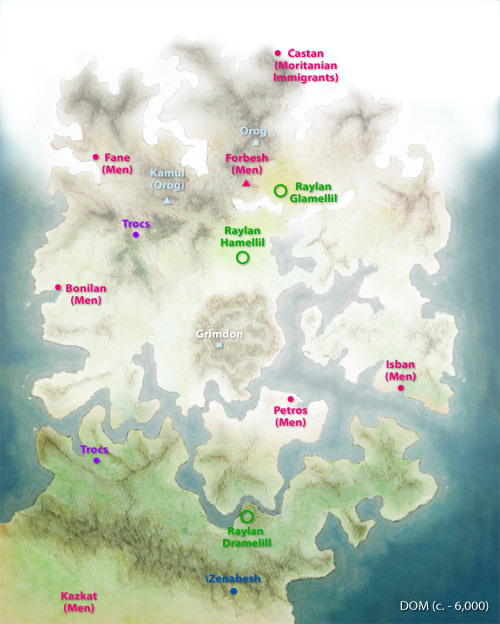
In -7,510 Petros, which rarely reached freezing a millennia earlier was now covered in ice all year round. Men drifted south from Fane to found and inhabit warmer Bonilan. Lack of ability to travel easily isolated people into tiny city-states. Old political and classification boundaries were forgotten. Magic had become synonymous with evil. Faiths became simpler. Soon the Sun would become a friend, a savior, and in the end was either worshipped as a God, such as in the early Paternal faith of the men of Isban or at least as a representation of one.
Here we leave a vast chunk of time in our tale. Little history of note occurred during this time of great hardship. Mostly, the past was washed away. Two things of importance did occur.
The first is that Kathubra receded during the Epoch. The need for sheer survival took her place. The weakened Goddess was eventually and easily sequestered on an island that now bears her name by entities within her own retinue, and by the vengeful efforts of the God Siomann, virtually extinct from the planet himself.
The second occurrence of note (at least for DOM) is that Castig immigrants from Morit seeking refuge from the crushing ice storms and loss of their land to the more aggressive southern Morits crossed the barren ice fields from their lands sometime around -6,000, traveling thousands of miles on the now hardened oceans and settling in New Castia. This would later be renamed Castan in honor of their great leader.
Lars Castan bore the scars of many battles. He could feel many of them at the moment. It did not do to complain. The sun was out finally. After thirty days. He would have his people cover many miles today and he would pretend that it would be easy. He shook his red mane of hair. "Stop thinking" he told himself. But his mind always drifted back to his Elsa. The scar he could not forget. Taken in a sudden spasm of ice and blood. There was a loud crack. Then a last look that seared into him deeper than the chasm into which she was about to travel - an instant burning admission and recognition of all that had passed unspoken between them for all of their years together. Then she was no more. They would all stop. They would stop right there. They would forget who they were. They would cry and whine like children. He could not let them. "We are Castig. This is a scar only." It would always be just a scar. The sun was finally out. "We go" he shouted and turned away. No look back. On his death bed nearly sixty years afterward, surrounded by the grateful faces of a delivered people he finally called out her name. But without complaint. Without tears. Then he went too. The scar was no more.
Next: The Path of Atarus
|
|
June 5, 2010 9:28
Posted By J Serembe
|
With the world left for dead at your feet, and a bad taste in your mouth for "civilization" you might be tempted to take some advantage. At around -8,000 the Rayla became saviors. Empathic Healing saved many from despair and chaos. By -7,900 they had become manipulators. The Raylans resistence to chaos allowed them to prey on the weakness of others. They were determined not to let civilization return to the past. By by -7,800 they were violent dominators. They practiced Empathics, but somewhere along the way they forgot how to feel empathy.
The great trees began to fall silent. They saw the sleeping groves as a sinister act by their only possible rivals - the other Raylan Groves. Unthinkably, Hamellil went to war Glamellil. In Dramellil far to the south, the same symptoms were evident. Shocked and dragged out of their innocence, the Dramellil could do nothing else but go to war against their northern brothers to stop the advancing decay of all that they held sacred.
They huddled in the snow together. Three thousand Raglan archers against the howling wind. Hamellil was before them. They could feel the sleepingTrees, but barely. They could smell fire too. They knew that the warmth of the groves were a distant memory here. Kalaiis sat among them. "They are blinded. I will not believe that they can ignore this forever" he thought burying his head in his cloak. "They have become orog." The mass of them held off the cold of the night, and at the dawn made ready. In less than a quarter hour they marched toward the ancient grove of Hamellil.
"They are coming" shouted Dunall "Steady your bows." But they could sense the weariness of their leader. He had been a rock. An impassable fortress. But lately they found access. Vulnerability. Self-imposed cracks allowing them in - telling them that he knew that it had somehow gone wrong. Hundreds of years of wrong. That they had dominated themselves.
The Dramellil entered the grove, bows drawn as they walked. In the clearing surrounding a great tree they met. Both awaiting the word to unleash piercing death. Dunall and Kalaiis met eyes. They steeled themselves against the anguish they were certain to suffer in a matter of seconds. Then suddenly all bows lowered. They knew - suddenly in that moment they all knew that war was over. For the first time in their history a Great Raylan Tree - the one directly before them - had just died.
The Rayla knew that their original intention had been a good one. To prevent the past from being repeated. They sought out the wisest of men in Isban and Petros, the Grimdon and the Sahag the few remaining Jasou in the conquered Zenabesh and worked with all of them to establish a pact between the elemental faiths. They agreed that Gods should never again roam Uranta. They constructed an Elemental Staff from each of the four elements with Power from the Alak-Ans still buried deep within Zenabesh. This staff could banish unwanted entities from Uranta. They all gathered the artifacts of the era of Gods and magic, and buried them deep within Zenabesh. They closed the demon portal in Forbesh. All of this finally accomplished, the Ralya ceased all contact with the world outside their groves. And one day 1,000 years afterward the great trees awoke once more. All but one.
Next: The Glacial Epoch
|
|
June 4, 2010 11:20
Posted By J Serembe
|
"We ride" shouted Rakis, Avatar of Fuegon, as he morphed into the largest of the seven Dragonlords. The others followed suit. High above the valley of Forbesh they began their flight. One by one they vaulted into the sky with a roar. Exultant peels of Fire lashing from their open maws. Today they attack Zimurac. Arriving, they swooped down belching flame, scorching the hills and raising vast clouds of steam from Lake Zimurac. Greeting them was the spectre of a gargantuan that suddenly rose from the depths of the lake. The Dragonlords swerved but one was hit and went down into the roiling water. Another broke south to the Valley of Shull. There the Grimdon were waiting. Thousands of boulders suddenly leapt from the ground striking the Dragonlord, who answered with a scorching breath that brought the hills to a burning inferno, but still he went down. Back in Zimurac, Rakis arrived at the Troc capital, the gargantuan spectre held in battle by the remaining four Dragonlords. Hovering above the island capital in the center of the lake, he called down a column of Fire upon it, following with Energy Storm and Hurricane Force. When all was fire and destruction, Fuegon the God himself appeared in the midst of the blaze to claim his victory. But Siomann was waiting. Zokesh had tapped into the hidden Necromancy of the Orb of Fire from centuries earlier and together he and Siomann sent a Greater succubis super-charged with Siomann's Enchantment to entrap Fuegon and his Avatar. Rakis was separated from Fuegon and sent to the God's temple which was soon to become relegated to obscurity. On Fuegon's greatest moment of victory, when he alone was the ultimate God over all of DOM and The Khaniz, he was led willingly into the same eternal dance party as the one to which he has sequestered Khaniza. To complete the deed, Zokesh opened a demonic portal in Forbesh at the Temple of Fuegon to smite Fuegon's followers. Many were possessed by lycanthropic entities. Within one generation, Fuegonism was dead and lost to the memories of only a few.
This scene was repeated the world over in many languages and in all places. Uranta lurched rapidly toward chaos and death. The Age of Magic was nearing a close. By -8,000, The Great Plagues had killed off the remainder of civilization. Kathubra alone was triumphant. Sioman was banished from the world by her hands. In the end he simply had no Avatar or followers left living that remembered him. Grimdon was all but destroyed, Kathubra took hold of Grimbold and the rest of DOM. The Trocs were decimated. Men were consumed by chaos and anarchy and overcome by disease. Ezmere and Zokesh had committed mutual destruction and left the spent plane.
The Rayla alone had survived in numbers and would write the final chapter to this tragic age.
Next: The Raylan Domination
|
|
June 3, 2010 7:58
Posted By J Serembe
|
The world of simple beings was over. The planet had grown too dangerous for survival. Disease, which did not affect the Gods devastated Urantans. Losing vast numbers of faithful was having an effect on the Gods. For without worshippers, the Gods are nothing. The Gods Fuegon and Siomann had established a tentative truce. Goddess Khaniza had grown too powerful and needed to be taken down. They both craved her followers, a vast number of humans in all parts of the Khanize Barrens used to hardship and resistant to disease.
The chaos surrounding the Prime Material Plane had attracted large numbers of entities that thrive on such mayhem. Queen of these entities was the Goddess Kathubra whose mortal followers originated in Tixtlan but were growing worldwide like a cancer especially in the small forgotten places. The places where men and beasts flee in times of oppression and cruelty. Her followers were never organized, and most never knew her name. In Pyramis they called her Zaizun. All of her names were pseudonyms for anarchy and chaos. This chaotic despair had attacked the very heart of Neriz, the city of Khaniza, and the natural insectoid inhabitants there. The Entarans lived in tunnels far below the city, tapping the same waters that refreshed the Khaniz of Neriz. Sensing, but not understanding the state of the world, they broke forth and began to destroy the city. Despite countless Timeslips and Time Spheres the Avatar of Khaniza was a casualty of the relentless blanket of Entarans. Khaniza was angry. She engaged Kathubra in battle in the Ethereal Plane. This was all that Fuegon and Siomann needed. As she plunged headlong into battle with chaos, she was beguiled by Siomann into believing that she had won. Her path back to the Prime Material led her instead to a powerful Magic Jar and an eternal party in the now trans-dimensional Fuegonite Great Hall of Humak. With no Avatar to discover her whereabouts, her influence waned and her people eventually scattered - living a nomadic life in the Khaniz Barrens. Even her beloved Neriz sunk into the sands.
But Fuegon and Siomann did not revel in their victory, for in their minds there could only be one true and eternal God of Uranta and they already had plans for each other. Competitiveness for dwindling followers not infected by chaos became paramount. Ezmere and Zokesh continued their endless war. Armies of demons and devils battling it out while men ran, hid and died in unknown places. Both Ezmere and Zokesh sought deific allies. It was understood that these alliances were to be short-lived. Zokesh had allied briefly with Fuegon to rid the Jasou of the Alak-Ans. Both coveted it. Fuegon summoned dragons from the Elemental Plane of Fire, and despite the Earth-rending machinations of the Jasou, the Dragons cleared a path for the Demons of Zokesh to take possession of Zenabesh in a single hour. The Alak-Ans had been deliberately buried by the Jasou to prevent its taking. The rapid destruction of the Jasou and their Avatar of Alak at the hands of hordes of demons - immune to Kinesis insured that the great gem would remain buried for awhile. The remaining Jasou were scattered to the winds and those that survived the desert and the Zokesh eventually drifted back to their ancient homelands in the southern hemisphere. Alak became a God without a people and he disappeared.
Zokesh had plans to unearth the Alak-Ans, but they never got the chance. Ezmere attacked their capital with massive Meteorics. Fuegon never got the chance to get his hands on it either as a secret alliance between Siomann and Zokesh would mark the beginning of the end of him and of the 1,000 year Age of Magic.
Next: What Goes Around Comes Around.
|
|
June 1, 2010 6:39
Posted By J Serembe
|
It is unclear where the race began. Perhaps with the Orb of Fire and gem Alak-Ans, but the desire to acquire large reserves of Power spread across Uranta. Eventually Power was not enough. Avatars began using their power to summon the Gods themselves. These etheric entities were far more powerful than the demonic ones brought by the Morbreth in Halifax.
Deities receive their Power through the worship of the faithful. Thus their legend and number of believers allows them their Power and abilities. These deities in turn redistribute the acquired Power among their faithful. This symbiotic relationship describes the nature of religion, Power acquisition, Low and High Magic in Uranta. (It's "Meze" or description of reality). Individual direct acquisition of Power from the Astral was deemed to small to be of use. During the Great Age of Magic, Gods walking Uranta was a natural outcome of the ability to conjure entities combined with an endless quest for Power. Having a gem of Power suddenly became somewhat passe - when your God himself was at the helm. The deities saw it as a chance to compete directly with other such deities, they relished the opportunity to drink in Power from the Astral Plane and to build their own "Meze."
But Gods generally have only the collective wisdom of their faithful. And there was little of that at this time. As went Halifax, so went Uranta. The devastation caused by nations of great Power and Gods weilded at each other can only be imagined now. But for hundreds of years terror and mayhem reigned. Powerful magics laying waste entire civilizations.
In DOM, Fuegon incarnate strode the hills of the Malpedun. He granted his "seven" the ability to morph into fire-breathing dragons. He allowed his Avatar the ability to call down huge columns of eternal Fire. And the Orb of Fire was placed in a new Temple that existed halfway between the ethereal plane once removed from the Prime, and the Elemental Plane of Fire. It's entrance was in Forbesh. Grimbold allowed his Grimdon Avatar the ability to rend the earth at will. To dig massive areas rendering them instant graves for his enemies. Siomann gave the Trocs the ability to beguile and enchant their enemies and produce huge specters and phantasms. The southern Portat Trocs were gifted with the transmutational power to Polymorph, contstruct vast phantams - then make them real with Permanence. Greater Etheric Entities were called forth by the Zorbeshis in the south. In the Khaniz Barrens, Khaniza gave the Dance of Fire to her faithful as a sign of their advanced Power for Energetics and Shamanism. Her Avatar could Call Wolves, alter reality and cast massive Timespheres. Powerful artifacts and engines of war were magically produced on all sides, especially by the Jasou. For nearly 400 years the Gods walked Uranta, powerful avatars reigned, and life was cheap and expendable.
Next: The Imprisonment of the Gods
|
|
June 1, 2010 6:30
Posted By J Serembe
|
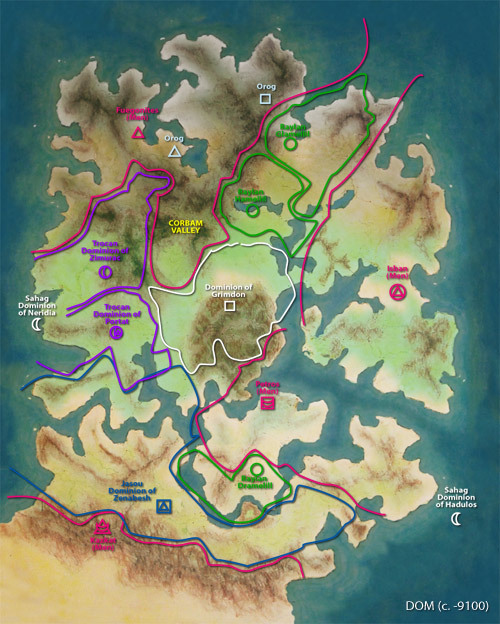
This map depicts the dominance of The Fuegonites and the advance of men and the Jasou (called "gnomes" by the Fuegonites). The Corbam Valley (in yellow) was the scene of The Battle of Corbam - an immense battle between the Trocs, Grimdon and the Fuegonites. The latter force won the day.
|
|
|
|

